

I
live in San Diego, California, and have been in love with the ocean for
as long as I can remember. I learned to scuba dive at age 15, and have
spent many years exploring the rocks, reefs and sand flats in the cool
waters offshore.
One of my biggest frustrations was my inability to convey, to friends and family who don't dive, my experiences while under water -- especially the beautiful and unusual sights below the surface. That changed when one of my friends lent me his underwater camera. I enjoyed it so much, I bought an inexpensive used Ikelite housing (which was made for an unknown camera), stuffed my Canon AE-1 into it, bent a few control rods to make it work, got the cheapest strobe I could find, and was off to Cozumel. Some of the first shots I took with that rig include the brittle star, the spotted moray and the juvenile octopus.
 Even today, I'm mostly stuck in the film age; I use a Nikon 8008s in a Subal housing. My primary lens is Nikon's
60mm macro, which is great for small to mid-sized fish and most macro subjects.
For more wary subjects, such as zebra gobies and
blennies, the 105mm macro allows tight shots while keeping a bit more distance.
Adding a +2 diopter allows even greater magnification -- although at a
cost of depth-of-field, and lately I've been experimenting with extension
tubes for higher magnification. A 20mm wide-angle works best for
kelp and reef scenics and large animals, like Mola
mola and Sea
Lions. For strobes, I use a Sea and Sea YS-60 and a couple of Nikonos SB-105's, mounted on TLC strobe arms. For film,
I use Fuji Velvia or Kodak E-100VS for macro shots. I've also been taking digital photos using a Canon SD550 in a Canon housing, and my Nikon D70s, when I can borrow a housing for it. I look forward to getting a housing for my D300 in the future.
Even today, I'm mostly stuck in the film age; I use a Nikon 8008s in a Subal housing. My primary lens is Nikon's
60mm macro, which is great for small to mid-sized fish and most macro subjects.
For more wary subjects, such as zebra gobies and
blennies, the 105mm macro allows tight shots while keeping a bit more distance.
Adding a +2 diopter allows even greater magnification -- although at a
cost of depth-of-field, and lately I've been experimenting with extension
tubes for higher magnification. A 20mm wide-angle works best for
kelp and reef scenics and large animals, like Mola
mola and Sea
Lions. For strobes, I use a Sea and Sea YS-60 and a couple of Nikonos SB-105's, mounted on TLC strobe arms. For film,
I use Fuji Velvia or Kodak E-100VS for macro shots. I've also been taking digital photos using a Canon SD550 in a Canon housing, and my Nikon D70s, when I can borrow a housing for it. I look forward to getting a housing for my D300 in the future.
 I am a past-President of the San Diego Underwater
Photographic Society, a great group of which I have been a member for over 15 years. The SDUPS is an organization whose members range from beginners to some of the most experienced professional underwater photographers in
the world. Membership in this great group has allowed me the opportunity
to not only grow as a photographer -- benefitting from the years of experience
among the other members -- but to make many new friends and dive buddies
as well. I highly recommend anyone interested in underwater photography join a group such as this.
I am a past-President of the San Diego Underwater
Photographic Society, a great group of which I have been a member for over 15 years. The SDUPS is an organization whose members range from beginners to some of the most experienced professional underwater photographers in
the world. Membership in this great group has allowed me the opportunity
to not only grow as a photographer -- benefitting from the years of experience
among the other members -- but to make many new friends and dive buddies
as well. I highly recommend anyone interested in underwater photography join a group such as this.
Dive operators of choice are Horizon Charters out of San Diego, which has provided many memorable dives at San Clemente, Santa Catalina and Santa Barbara Islands, and Truth Aquatics out of Santa Barbara, which goes to the northern Channel Islands, including San Miguel, Santa Rosa, Santa Cruz and Anacapa. Both outfits are first-class, and never fail to find excellent diving, regardless of the conditions.
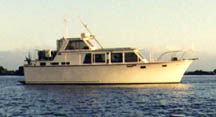 Of course, I'd be remiss if I didn't mention my father's boat, the Good
Question, which was the platform for several great trips to San Clemente and Catalina Islands. Thanks, Dad!
Of course, I'd be remiss if I didn't mention my father's boat, the Good
Question, which was the platform for several great trips to San Clemente and Catalina Islands. Thanks, Dad!
Much of the Scientific information within this website
comes from Coastal Fish Identification; California to Alaska,
by Paul Humann, 1996; Pacific Coast Nudibranchs, 2nd Ed.,
by David W. Behrens, 1991; and the Guide to Marine Invertebrates;
Alaska to Baja California,by Daniel W. Gotshall, 1994. These books
provide an invaluable wealth of information on the many critters found
beneath the waves off our coast.
| I hope you enjoy viewing my images as much as I enjoy creating them. |  |
